


Reclaiming Your Fire - A Man’s Natural Guide to Energy, Drive, and Confidence After 40
Reclaiming Your Fire - A Man’s Natural Guide to Energy, Drive, and Confidence After 40
Limited offer! Ends at midnight:
 Instant delivery via email right after purchase
34 real remedies: dosage, how to use, why it works
Backed by real clinical research for each herb
A realistic 4-week reset - no empty promises
Couldn't load pickup availability
- American express payment method
- Apple pay payment method
- Google pay payment method
- Shopify pay payment method
- Discover payment method
- Visa payment method

Reclaiming Your Fire - A Man’s Natural Guide to Energy, Drive, and Confidence After 40

There's nothing screaming "illness" here. Your bloodwork, if you've had it done, probably came back "normal." Yet something isn't the same as before and you know it!
Does This Book Replace Medical Advice from a Doctor?

Does This Book Replace Medical Advice from a Doctor?
NO.
The information provided in this book is for educational and informational purposes only. It is not intended to substitute for professional medical advice, diagnosis, or treatment by a qualified physician or healthcare provider.
How will I receive my order?

How will I receive my order?
After your payment is completed, you’ll get an email containing the download link(s) for your files.
You can also access your order immediately after payment by clicking “Access my order”.
Great! Feel free to enjoy your video training, books, and spreadsheets however you like.
You can always find your order later by going to the “Member Area” menu. Just make sure to log in using the same email address you used when placing the order.
What are the best natural remedies for common health problems?
What are the best natural remedies for common health problems?
This comprehensive book brings together 200 powerful natural formulas into one complete and easy-to-follow system.
Using simple, quick, and 100% natural recipes, the book provides clear daily guidance that easily fits into your busy lifestyle. Most preparations take only a few minutes using common ingredients you probably already have in your kitchen.
Whether you want to support weight loss, detoxification, glowing skin, higher energy, stronger immunity, or other everyday health concerns, this book delivers a progressive and accessible approach with visible and long-lasting results.
Will this method still work even if I have no experience with herbal medicine?
Will this method still work even if I have no experience with herbal medicine?
Absolutely. This book is written for regular people, not experts. Each recipe is explained step-by-step in a simple and clear way, so anyone can follow and use it successfully without any prior knowledge of herbalism.
How does our program differ from other books on medicinal plants?
How does our program differ from other books on medicinal plants?
Most books about medicinal plants tend to overwhelm readers with rare ingredients or questionable claims. Ours is different. Every remedy is based on both traditional wisdom and modern research, using common plants and ingredients you likely already have in your kitchen.
Additionally, the program is specifically designed to help you achieve clear, targeted goals such as weight loss, beauty enhancement, detoxification, and more.
Is there a guarantee?
Is there a guarantee?
Yes! We provide a 30-day money-back guarantee after your purchase.
If the program doesn’t meet your expectations, you can easily request a full refund - no questions asked.
 Instant Delivery by Email
 30-Day Guarantee
 24/7 Support




About the Author
Dr. Sjors Klijs is a sports medicine and endocrinology specialist in Utrecht. In his late 40s, his own energy and drive quietly dropped, something he'd dismissed in patients for years as "just stress."
"I finally checked my own bloodwork," he says. "Testosterone declining, right on schedule, and I'd been the last to notice it in myself."
This book is the same plan he used to bring it back, built on what the research actually supports, not what sells.
Tired in a way sleep doesn't fix. Snapping at your kids over nothing. Sex crossing your mind less, not more.
Maybe it's just work, just age. Fair. But testosterone runs mood, drive, patience, not just the bedroom, and it can drop slow enough you don't notice for years.
Women get a name for this, menopause. They talk about it, compare notes with friends, their doctor. Guys don't. So most just quietly assume it's their own problem.
It's not. It has a name, and it has remedies that work.
Is This You?
"An honest two-minute checklist. No score to beat just a clearer picture of where to start."
And If two or more of these sound familiar, this book was written with you in mind.
-

Desire & Drive
- A clear drop in interest compared to 5-10 years ago
- A less reliable physical response, or one that takes more effort than before -
Energy & Stamina
- Waking up tired even after a full night's sleep
- An afternoon crash that coffee no longer fixes -
Body & Metabolism
- New or growing belly fat despite no major diet changes
- Bloating, slow digestion, or feeling "heavy" after meals -
Mood & Mind
- Irritability or impatience that feels out of character
- A flat feeling, going through the motions, losing the drive you once had -
Sleep & Recovery
- Trouble falling asleep, or waking mid-night unable to get back to sleep
- Your body no longer seems to bounce back from exercise or stress like it used to -
Doubt & Disconnection
- You've quietly wondered if this is just who you are now
- Your partner has mentioned the distance between you lately, and you didn't know what to say back
- Blamed stress for everything, low energy, low drive, a short temper he didn't recognize in himself.
- Assumed nightly bathroom trips were just part of getting older.
- Ashwagandha most nights, fenugreek in the morning, two resistance sessions a week. "Not a different person," he says, "just the one I remembered."
- Saw palmetto and nettle root with dinner. Fewer trips, deeper sleep, and energy he hadn't expected to get back.
What's Really Happening in Your Body?
1. The Silent Decline: 1-2% a year
1. The Silent Decline: 1-2% a year
Testosterone doesn't crash suddenly in your 40s. It slides gradually, averaging 1-2% per year from around age 30. By your late 40s or 50s, that slow slide has often added up to something you can't ignore: libido, energy, muscle tone, mood. Because it's gradual, it's easy to blame on work stress or "just getting older." Most men never get their levels checked, simply because no one suggested it.
2. The Hidden Brake: Testosterone and cortisol
2. The Hidden Brake: Testosterone and cortisol
Your main stress hormone, cortisol, and testosterone share raw materials and compete for priority in your body's hormone production. Under chronic stress that never resolves, night after night, month after month, your body prioritizes cortisol, which can actively suppress testosterone over time. This is one of the least discussed mechanisms behind the "I'm exhausted and don't feel like myself" pattern that brings many men to this book in the first place.
3. The Belly Fat-Estrogen Loop
3. The Belly Fat-Estrogen Loop
Fat tissue contains an enzyme called aromatase that converts testosterone into estrogen, and belly fat specifically ramps up aromatase activity. More belly fat converts more testosterone away, which makes it harder to lose that fat and easier to feel low on energy and desire. It's a genuinely self feeding loop, not a one time hormonal dip.
4. The One Most Men Never Hear: Sleep
4. The One Most Men Never Hear: Sleep
Most of a man's daily testosterone release happens during deep sleep, concentrated in the early morning hours. Chronically short sleep, even just 5-6 hours a night for months or years, has been linked in research to significantly lower testosterone, regardless of age. In practice, this means a man who fixes his sleep and does nothing else can outperform a man taking every remedy in this book while still sleeping five broken hours a night.
Honest About What the Research Actually Shows
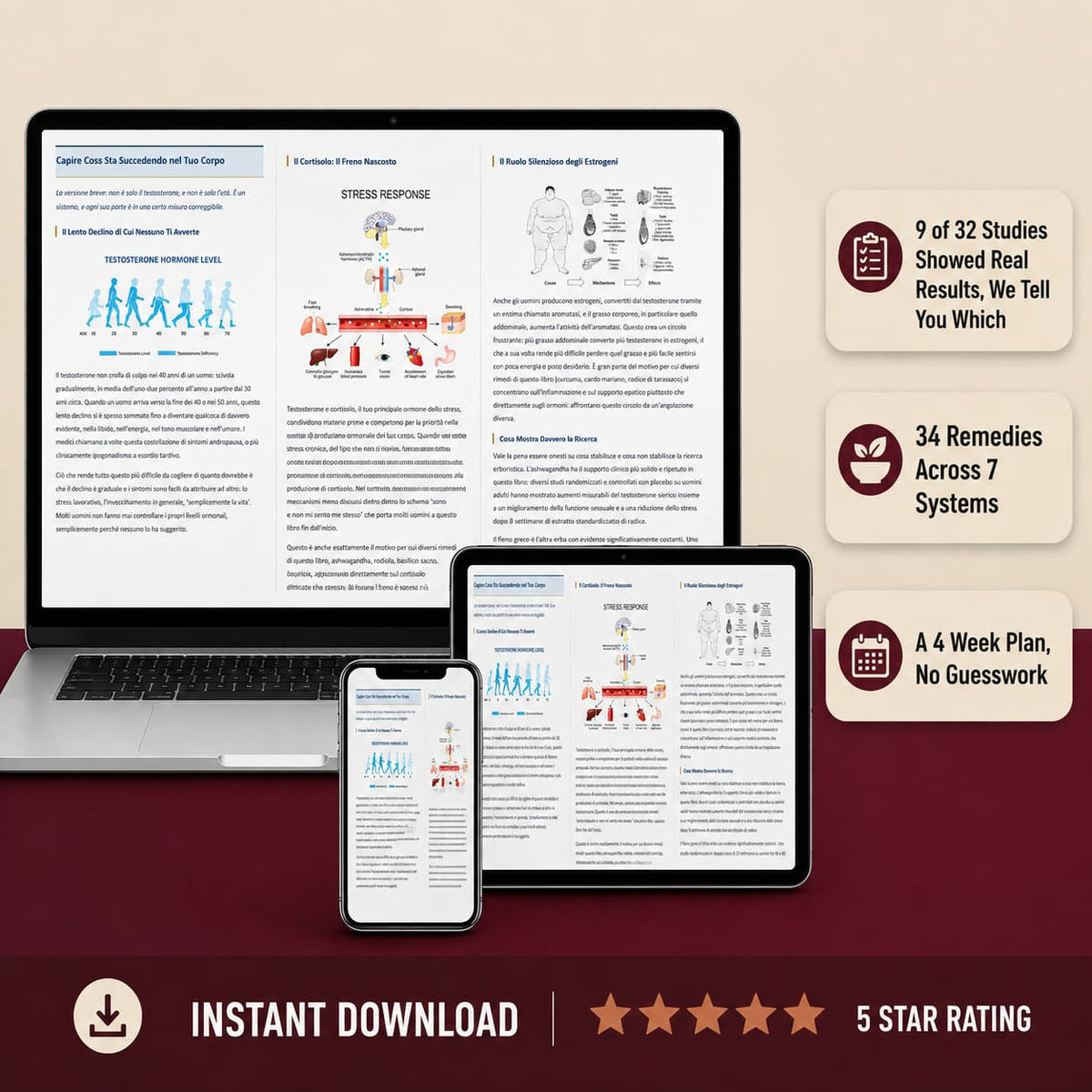
Of 32 published studies on herbs and testosterone, only 9 showed real effect, ashwagandha and fenugreek most consistently.
IMPORTANT: Knowing the names isn't the hard part, you can buy them anywhere. The harder part is knowing which of the 7 systems in this book your specific symptoms point to, what dose actually matches the clinical studies (not the vague "as directed" on a random bottle), whether to take it morning or evening, how long to cycle it, and what it's safe or unsafe to combine with the blood pressure medication you're already on. That's the part a pharmacy shelf won't tell you!
Collapsible content
Ashwagandha
Ashwagandha
Multiple placebo-controlled RCTs in adult men found measurable increases in serum testosterone along with improved sexual function after 8 weeks of standardized root extract.
Fenugreek
Fenugreek
12-week double-blind study in men aged 40-80 measured significant increases in free and salivary testosterone with a standardized extract.
The 4-Week Reset - No Need to Do It All at Once
If you haven't noticed meaningful change after 8 consistent weeks, that's useful information too . It may be time to adjust your combination, look more closely at sleep and stress, or bring this checklist to a doctor for bloodwork.
When to See a Doctor
• Sudden or severe erectile difficulty, especially if it appeared quickly rather than gradually, this can occasionally signal a cardiovascular issue and deserves prompt evaluation
• Blood in your urine, or significant difficulty urinating at all
• Unexplained weight loss, night sweats, or fevers alongside other symptoms
• Chest pain, shortness of breath, or an irregular heartbeat, with or without other symptoms in this book
• Significant, persistent low mood, feelings of hopelessness, or thoughts of harming yourself, this deserves immediate professional support, not a home remedy
• A lump in the breast or unusual changes in male breast tissue (gynecomastia can sometimes signal a hormonal imbalance worth investigating)
• Symptoms that haven't improved after 8-12 weeks of consistent lifestyle changes and remedy use
• Any new symptom that worries you, even if it doesn't clearly fit this list
If you're having thoughts of harming yourself or going through a mental health crisis, contact a crisis line or mental health professional in your country immediately, in addition to anything else in this book.
FAQ

How does our program differ?

How does our program differ?
Most books in this space promise every herb works. This one is built around a systematic review of 32 published clinical studies on herbs and testosterone. Only 9 showed a statistically significant effect, with ashwagandha and fenugreek standing out as the most consistently positive.
Rather than overselling all 34 remedies equally, it tells you plainly where the strongest evidence actually is, and where a remedy still has real value for a related goal, sleep, circulation, stress, even if the testosterone specific data is thinner.
Is andropause a real medical condition?
Is andropause a real medical condition?
Yes. It's often clinically referred to as late-onset hypogonadism - the gradual, age-related decline in testosterone and its associated symptoms.
Do I need to use all 34 remedies?
Do I need to use all 34 remedies?
No. Most men see real, lasting change from consistently using two or three remedies matched to their specific symptoms, combined with the lifestyle habits in the book.
How long before I see results?
How long before I see results?
After 1 week: subtle changes. After 2-4 weeks: many men start noticing steadier energy and mood. After 4-8 weeks: the window where clinical studies show the strongest results.
Can I combine several remedies at once?
Can I combine several remedies at once?
Yes, but introduce them one at a time, a few days apart, and stick to 2-3 when starting out so you can tell what's actually helping.